Salar de Uyuni Guide 2026
The real, unfiltered story of standing on the world's largest mirror — and not losing your damn mind doing it.
Salar de Uyuni Guide 2026: The Real, Unfiltered Story of Standing on the World's Largest Mirror (and Not Losing Your Damn Mind Doing It)
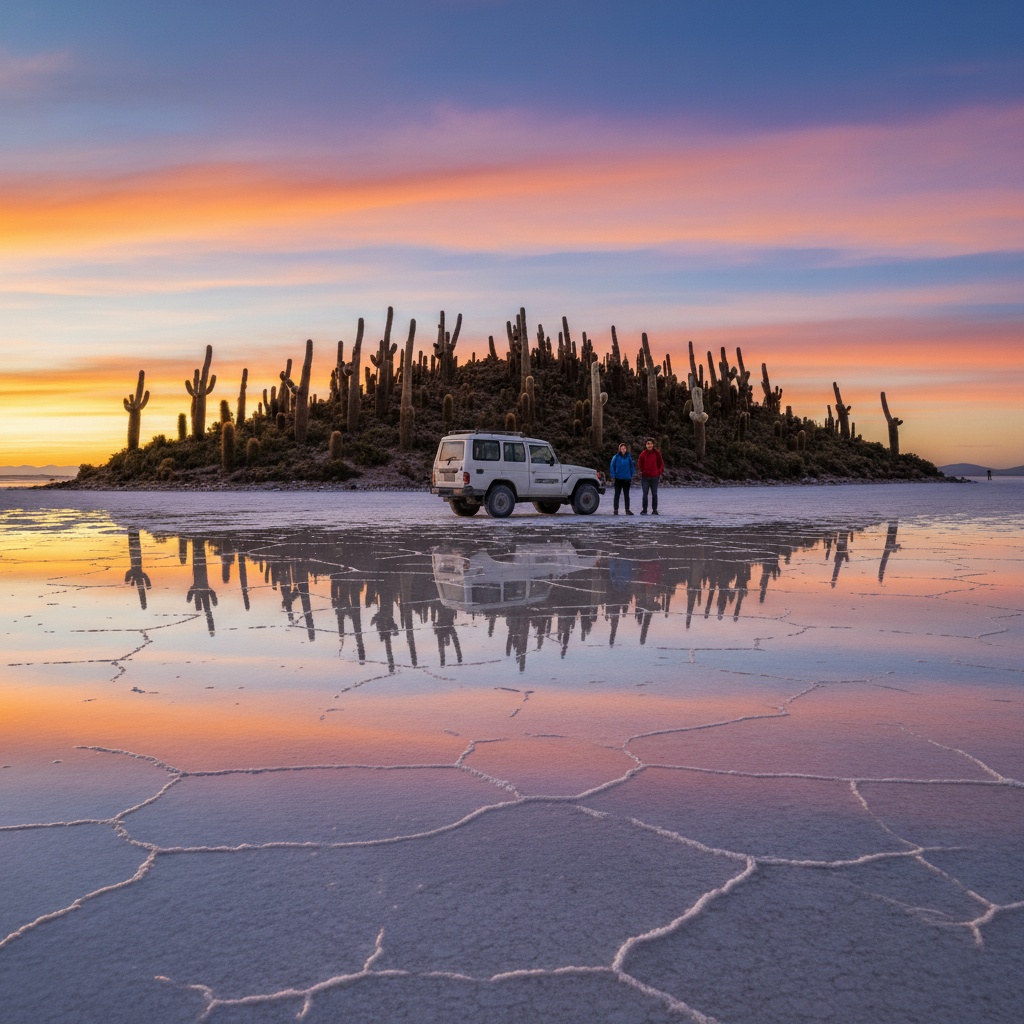
I still remember the exact second the jeep rolled to a stop on day one and the driver just cut the engine. No music, no talking, just wind and the sound of my own breathing. The white stretched so far in every direction that my brain couldn’t decide where the ground ended and the sky began. Then the sun hit the thin layer of water at just the right angle and the whole salar turned into glass. Sky below my boots. Clouds floating under my feet. Me — tiny, stupidly happy me — reflected forever. That’s Salar de Uyuni. Not the postcard. Not the drone shot. The real thing.
I’ve done this salar five times now (three in rainy season, two in dry), once with a broken-down jeep at 4,800 meters, once alone with an overlander who barely spoke, once with a group of six strangers who became friends by day three. This guide is not trying to sell you anything. It’s what I wish someone had told me before my first trip in 2024 — updated for the prices, weather quirks, and small but real changes of 2026.
Salar de Uyuni basics — what you're actually signing up for
The world's largest salt flat: 10,582 km² of almost pure halite crust, sitting at 3,656 m above sea level. Underneath — a brine lake with the planet's biggest lithium reserves (still mostly untapped in 2026, thank god). Formed from prehistoric lakes that dried up ~40,000 years ago. Six meters thick in places. Hexagonal salt patterns that look alien. And twice a year, when it rains just enough but not too much, a perfect mirror that makes people cry on Instagram.
In 2026 the salar is still mostly the same — but tourism pressure is rising. Mirror season (Dec–Apr) gets booked earlier, some agencies are pushing "eco" labels while still handing out plastic bottles, and a couple of hybrid jeeps are quietly testing on the routes. The good news? It's still cheap. The bad news? Cheap can mean reckless.
Uyuni rainy season vs dry season 2026 — which one should you chase?
Rainy season (December–April, peak Jan–Mar)
Mirror effect: sky reflected in 2–10 cm water. Photos look fake even when real.
Crowds: lighter than dry peak
Roads: mud, possible reroutes, some lagoons skipped
Mirror odds: highest Jan–early Feb, calm mornings/sunset
Price: slightly lower ($180–400 for 3 days)
Dry season (May–November)
Classic white expanse, razor-sharp perspective illusions
Crowds: heavier July–August
Roads: solid, reliable
Best light: sunrise/sunset golden hours
Price: $200–450 for 3 days
Uyuni Salt Flats tour prices & options in 2026 (what's realistic right now)
Classic 3-day/2-night shared tour
• Basic Spanish-guide (6 people/jeep): $190–270 (dorm/shared rooms, simple meals, salt hotel night 1, refuge night 2)
• Private room upgrade: +$40–80
• English-speaking + better lodging/meals: $300–480 (Viator/GetYourGuide often $340–460)
4-day/3-night $280–550 (more salar time, return options or Atacama finish)
From La Paz (overnight bus + tour) Add $20–40 bus → total $210–520
From San Pedro de Atacama (Chile border start) $180–450 (reverse route — lagoons first, salar finale)
Extras (cash only — bring more than you think)
Eduardo Avaroa reserve: $22–26
Incahuasi Island: $5–6
Hot springs/showers/toilets: $1–4 each
Water/snacks/tips: $30–70
Book online (Nomades, GetYourGuide, Viator) for reliability. Street agencies in Uyuni can undercut by $20–40 but risk old jeeps and poor planning when roads flood.
What a 3-day Salar de Uyuni tour actually feels like (day-by-day)
Day 1 Pickup Uyuni 10:30–11 am. Train Cemetery — rusty locomotives, moody photos. Colchani — salt factory, souvenirs. Lunch on salar. Perspective illusions — guide helps with positioning. Sunset — golden hour turns everything orange/pink. Night 1: salt hotel (walls salt, no heat, freezing).
Day 2 Sunrise over salar (best mirror chance if calm). Drive south into reserve. Laguna Colorada — red water, flamingos. Sol de Mañana geysers — sulfur steam. Polques hot springs — dip if you brought swimsuit. Siloli Desert + Árbol de Piedra. Night 2: high refuge (-10…-20 °C). Bring layers.
Day 3 Sunrise over another lagoon. Return drive — back Uyuni 5–7 pm.

Salar de Uyuni photography tips (because everyone wants the shot)
• Wide-angle mandatory (16–35 mm)
• Polarizer filter — deepens sky, kills glare
• Golden hour only — midday light kills contrast
• Low angles for perspective illusions
• Mirror season — calm water, sunrise/sunset symmetry
• Bracket exposures — high dynamic range
• Drone — restricted in reserve, fines high
Packing for Salar de Uyuni tour 2026 (don't learn the hard way)
Thermals + fleece + down/puffy, hat & gloves & neck gaiter, waterproof jacket (rainy season), rubber boots (mud), SPF 50+ & polarized shades, power bank & headlamp, altitude meds & ibuprofen & rehydration salts, swimsuit, small BOB/USD bills, reusable bottle, snacks.
FAQ — questions people actually ask before Salar de Uyuni 2026
Salar de Uyuni guide 2026 best time? Rainy Jan–Mar for mirror, dry May–Nov for classic white.
Salar de Uyuni tour price 2026? 3 days $190–480 shared.
Salar de Uyuni rainy season mirror effect 2026? Jan–early Mar peak, calm mornings/sunset.
Salar de Uyuni photography tips 2026? Wide lens, polarizer, low angles, golden hour.
Salar de Uyuni from La Paz 2026? Overnight bus + tour, $210–520 total.
Salar de Uyuni from Atacama 2026? 3-day reverse route, $180–450.
Salar de Uyuni independently 2026? Possible but expensive/risky — rent 4x4.
Salar de Uyuni sustainable tours 2026? Nomades Green, community jeeps — small groups, no plastic.
Salar de Uyuni 1 day tour 2026? $65–130 — teaser, no lagoons.
Salar de Uyuni altitude sickness 2026? Acclimatize La Paz 2–3 days, coca tea, hydrate.
The salar doesn't care if you're ready. It just sits there — massive, indifferent, blinding — waiting for you to show up. In 2026 it's still possible to stand in the middle of that mirror and feel like the only person on Earth. Go. Chase the light. Bring layers. And when the wind dies and the reflection appears… don't just take the photo. Stand there. Feel it. That's the part no camera catches.
If you're stuck choosing between rainy and dry, or want help picking an operator — ask. I'll tell you what actually worked for me.
Safe roads. See you on the white.